Slime Science: What is Slime & How Does Baking Soda Influence it?
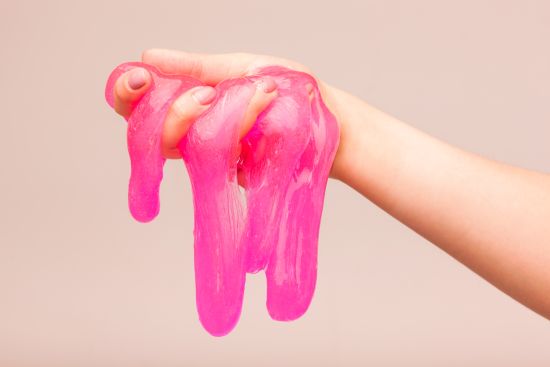
From Nickelodeon to Hollywood, slime has carved out its own little niche over time. The NFL even has an entire broadcast that employs a fun use of slime whenever teams score touchdowns! It’s the gooey substance that seems to capture our imaginations, and it can make for quite a fun accessory during arts and crafts time. But what is slime?
Let’s take a deep dive into the science of slime: what it’s made of, how you can make it stiffer and stretchier, and how baking soda influences slime. You’ll also learn about viscosity and the scientific properties of the sticky substance. So, ready to get “slimed”?
What is Slime Made of?
Slime is a thick, sticky substance made from a chemical reaction between a polymer (such as glue) and a gelling agent (such as contact lens solution, shampoo, or dish soap) that serves as a “slime activator.” Slime is a non-Newtonian fluid, meaning it acts differently when placed under stress.
Most slime recipes include clear or white polyvinylacetate (PVA) glue to go along with the activator. Polymers bind together when they engage with the gelling agent. These polymer chains are bound together by weak hydrogen bonds, which are easily broken when placed under stress.
Viscosity and Slime
One of the fun components of slime has to do with its variable viscosity or the measure of a fluid’s resistance to a change in shape. The higher the viscosity of a fluid, the thicker it is and the harder it is to stretch. How does this relate to slime?
The activator you use—and how much of that activator you use—impacts the viscosity of your slime. Glycerin, for example, can help alter the interaction between the molecule chains when polymers bind together, making your slime soft and stretchy. Water is typically used as a partial slime activator because it adds softness.
Is Slime a Liquid or a Solid?
As a non-Newtonian fluid, slime has the properties of both a liquid and a solid. Remember: the viscosity of slime changes as you apply a larger force.
As a slime enthusiast, you have the power to determine whether slime behaves more like a solid or a liquid by manipulating the amount of force you apply. The shape is also influenced by the slime activator you choose and the quantity you use during the slime-making process.
So now the question becomes: how can you make your slime stretchier, or perhaps thicker and stickier? This is where the magic of baking soda comes into play!
Make Your Baking Soda Slime Activator in No Time
If you’ve never made slime before, or if you’re trying to unlock your kiddo’s creative juices by having them make slime, the end product isn’t always what you desire. It’s common for slime to come out too runny or too gooey, which can make it difficult to stretch and mold the slime to your liking. Or maybe your slime isn’t stretchy enough!
One way to help ensure you get the appropriate slime texture is by using baking soda as an activator. You can add more baking soda to your slime recipe to help “fix” overly oozy slime, or lessen the amount in your recipe when you want spectacularly stretchy slime!
Plus, there are multiple things you can use to pair with baking soda to make a great gelling agent. For more, read about the five ways to make slime with baking soda.
How Baking Soda Activates Slime
We mentioned how glycerin helps break down bound polymer chains. Conversely, baking soda can help make polymer chains stick together more, making them stronger. That’s why baking soda is sometimes used in combination with super glue for surface repairs. Baking soda helps to firm out the shape of your slime.
It’s important to note that the ratio of baking soda to contact lens solution, shampoo or dish soap used will impact slime texture.
How to Use Baking Soda to Harden Slime
You probably want your slime to have at least a bit of an oozy and gooey form. At the same time, you want slime that you’re able to twist, bend, and mold to your liking. Plus, you likely want to avoid feeling like you’re playing with the slobber from a giant three-headed dog!
As we just discussed, adding more baking soda to your slime recipe can firm up your slime. For example, you may add equal parts ARM & HAMMER™ Baking Soda and contact lens solution (1 tbsp) to 4-6 Fl oz. of glue to make thick “sand” slime. Or, you might add ½ tbsp baking soda to 1-2 Fl oz. contact lens solution for an activator that may help produce a stretchy but firm texture.
Regardless, if your slime gets a bit runny or drippy, you can add a pinch of baking soda to make it firmer and get your preferred shape.
How to Make Stretchy Slime Using Baking Soda
Want a gooey slime that seems to sift through your fingers? Or something more befitting for spooky season? After all, holidays like Halloween make for the perfect opportunity to help your kid(s) create a slippery glow-in-the-dark slime.
You only need ¼ tbsp ARM & HAMMER™ Baking Soda mixed with 1 tbsp contact lens solution to make a slime with a stretchier texture. You might consider using the ARM & HAMMER™ Baking Soda Shaker to avoid accidentally adding too much, as the dual-sided shaker lid allows for both precise measurement and easy sprinkling.
Note that you can also add a little bit of water to help soften your slime if it comes out too hard initially. And, if you’re making slime with baking soda and shampoo, you can keep adding shampoo until it’s a bit creamier and runnier.
Use Baking Soda to Create Your Super Slimes!
Part of the fun in making slime has to do with how you can dress it up and design it to your liking. There are tons of specialty slimes you can introduce to your kids, and ARM & HAMMER™ Baking Soda can help you create them! Break out the baking soda and give your kids a fun lesson in science while you sculpt your slime.